Table of Contents
Quick Answer: Automated SSL suits many certificates and frequent renewals. Manual management can stay practical for a few certificates or where every change needs approval. Many teams automate renewal and keep manual approval for deployment.
When your next SSL certificate expires, who installs the replacement, and how do you know it worked? If the answer is a person following a checklist, you are relying on that person to track the date, complete validation, install the certificate and reload the server, every time, for every site.
Shorter certificate lifetimes make that harder. The maximum validity of a publicly trusted certificate is now 200 days and falls to 47 days by 2029. If you are weighing automated SSL vs manual SSL, this blog is just for you. It explains the difference, the cost, and how to choose.
Automated SSL vs Manual SSL: What Is the Difference?
Manual SSL means a person tracks expiry and completes every renewal step. Automated SSL usually means ACME: an ACME client, the software that talks to the certificate authority (CA), handles requests, validation and renewal. ACME is a protocol, not a CA or a certificate. For the details, read our guide on what the ACME protocol is.
| Area | Manual | ACME |
|---|---|---|
| Renewal | A person starts it | The client runs it on a schedule |
| Validation | Done by hand | The client completes HTTP-01 or DNS-01 |
| Deployment | Copy files, reload | A plugin or hook, if you configure it |
| Alerts | Only what you build | Logs exist; alerts need your own monitoring |
| Effort | Repeats every renewal | Mostly setup and oversight |
| Scale | Grows with each certificate | Same process for many domains |
| Best for | Few certificates, restricted systems | Servers, hosting, cloud, containers |
What Is the Manual SSL Certificate Renewal Process?
Each renewal follows the same steps: track the expiry date, generate a CSR, order the renewal, complete validation, install the certificate and chain, then reload and verify. Every step needs a person, and a missed reminder or a server that was never reloaded can leave the old certificate in place.
Manual management is not wrong. It gives you control over change windows and suits strict approval rules and devices without ACME support. It works best when you keep a short inventory and a written checklist.
How Does Automated SSL Work?
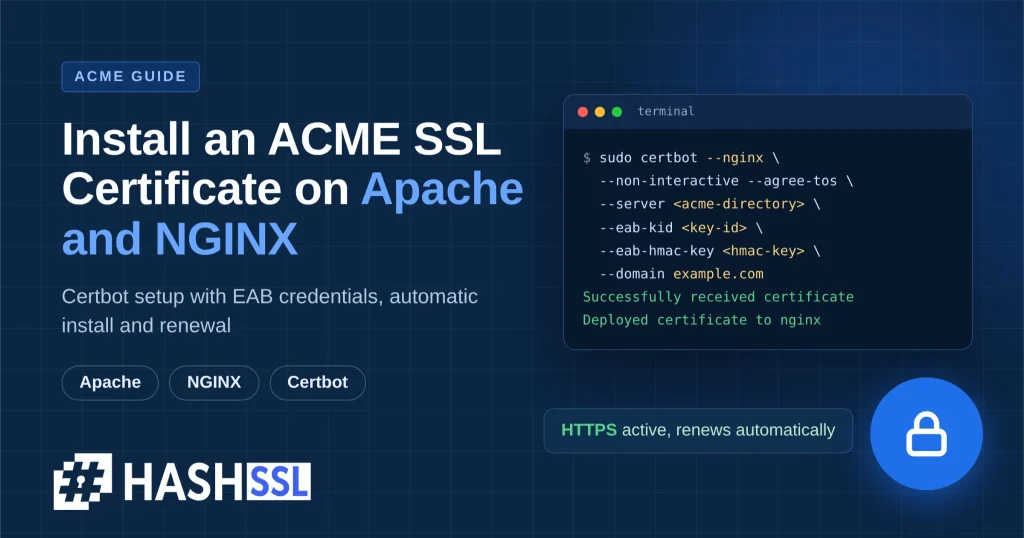
The client requests a certificate, proves domain control, receives the certificate and repeats the process before expiry. A server plugin or deployment hook installs it and reloads the service, where you have set that up. Wildcard certificates need DNS-01.
You still own the credentials, such as DNS API tokens, the client configuration and the alerts. For setup steps, see our SSL certificate automation guide.
What Is the Cost of Manual SSL Certificate Management?
The certificate price is only part of the cost. Manual management adds staff time for each renewal and the risk of a missed installation. ACME adds setup, client maintenance and monitoring. Neither approach has a fixed cost, because it depends on how many certificates you renew. Affordable automated SSL is mostly a question of effort and scale, not only price.
Why Do Shorter SSL Certificate Lifetimes Matter?
Under CA/Browser Forum Ballot SC-081v3, the maximum validity of publicly trusted certificates falls in stages, for certificates issued on or after each date:
| Issued on or after | Maximum validity |
|---|---|
| 15 March 2026 | 200 days |
| 15 March 2027 | 100 days |
| 15 March 2029 | 47 days |
These are maximums, not recommended renewal intervals. With 47-day SSL certificates, one certificate needs many renewals a year, so inventory, scheduling and SSL certificate expiry prevention matter more.
Can ACME Work with Paid, OV and EV Certificates?
Yes, when the CA offers ACME for that product. Paid ACME certificates usually use External Account Binding (EAB). ACME completes domain validation only. For OV and EV, the CA must validate your organization first. Sectigo’s documentation describes this for its ACME subscriptions (Sectigo OV and EV). HashSSL offers Sectigo ACME Certificate-as-a-Service.
Which Approach Should You Choose?
| Your situation | Suggested approach |
|---|---|
| One small site | Manual, or the ACME your host runs |
| Several domains | ACME for DV, manual for the rest |
| Agency or hosting provider | ACME with monitoring |
| Strict change control | Hybrid: automate renewal, approve deployment |
| Automation not supported | Manual with a strong inventory |
What Are SSL Certificate Management Best Practices?
- Keep an inventory with domain, CA, owner and expiry date.
- Renew with a safety margin, not on the last day.
- Limit API and DNS permissions.
- Test the reload, not only issuance, and alert on failures.
- Check the certificate the server actually serves with the HashSSL SSL Checker.
Conclusion
Manual management remains reasonable for a few certificates. ACME automation gives a practical advantage at scale, and a hybrid often fits best. To explore paid ACME certificates, see [Relevant HashSSL product page] or contact our team.
Can I use ACME with a paid SSL certificate?
Yes, if the CA offers ACME for that product. Paid ACME usually uses External Account Binding (EAB) credentials that link your ACME client to your paid account. Check supported certificate types and clients before you buy.
When is manual SSL management better?
For a few certificates, devices that cannot run an ACME client, or environments where every change needs approval. Keep an inventory and reminders, because renewals become more frequent as lifetimes shrink.
What happens if ACME renewal fails?
Your current certificate keeps working until it expires, so a failure is a warning, not an outage. Read the client log, fix the cause, such as blocked validation or a failed hook, and rerun renewal before expiry.
Do I need ACME for a single website?
No. One site can be renewed by hand, and many hosting panels already run ACME for you. ACME becomes more useful as renewals get more frequent.
Does ACME work with OV and EV certificates?
Sometimes. ACME automates domain validation only. For OV and EV, the CA must validate your organization first and must offer ACME for that product. Confirm the exact product before you plan around it.
What is automated SSL?
Automated SSL means software requests, validates, and renews certificates from a CA with little manual work. It usually uses an ACME client and the ACME protocol. Deployment and alerts depend on your setup.
Is manual SSL renewal still worth it?
For a handful of certificates with a clear owner, yes. It is harder to justify as the count grows and maximum validity falls to 200, 100 and then 47 days.
How do I automate SSL certificate management?
Make an inventory, pick an ACME client that fits your server and validation method, test renewal, add a deployment step and set independent expiry alerts. Our SSL certificate automation guide shows the steps.
How do I manage SSL certificates for multiple domains?
Keep one inventory with domain, CA, expiry date, owner, and server. Use one renewal process per CA and validation method. DNS-01 helps with wildcards and servers that are not public.
What is the cost of manual SSL certificate management?
The certificate price is only part of it. Manual work adds staff time for every renewal and the risk of a missed installation. The total depends on how many certificates you renew and how often.
How do shorter SSL certificate lifetimes affect renewal?
What should I check before choosing an ACME client for a paid certificate?
Check for External Account Binding (EAB) support, your server and operating system, the validation method you need and how it handles deployment hooks and errors.